Savings Challenge Ideas: 9 Challenges With Real Totals
A savings challenge is a set of small saving steps with a clear goal, usually tracked on a printable chart you color in as you go. Below are 9 savings challenge ideas, what each one really adds up to, how much it takes per week, and how to pick one that fits your budget.
Savings challenges compared
| Challenge | Total saved | About per week |
|---|---|---|
| Penny challenge (365 days) | $667.95 | $12.85 |
| 52-week challenge | $1,378 | $26.50 on average |
| $1,000 in a year | $1,000 | $19.23 |
| $1,000 in 6 months | $1,000 | $38.46 |
| 100 envelope challenge (over a year) | $5,050 | $97.12 |
| $5,000 in a year | $5,000 | $96.15 |
| $10,000 in a year | $10,000 | $192.31 |
| No-spend month | Depends on you | None |
| Sinking funds | Your goal | Your choice |
Per-week amounts are rounded and assume you spread the total evenly over 52 weeks (26 weeks for the 6-month version).

9 savings challenge ideas
1. The penny challenge
Save 1 cent on day 1, 2 cents on day 2, and so on up to $3.65 on day 365. It adds up to $667.95. It starts tiny, which makes it a gentle first challenge. The last months ask for $2 to $3.65 a day, so some people do it in reverse and start with the big days.
2. The 52-week challenge
Save $1 in week 1, $2 in week 2, up to $52 in week 52, for a total of $1,378. The reverse version starts at $52 and counts down, so the hardest weeks come in January when you are most motivated, not in December when holiday costs hit.
3. The $1,000 challenge
Draw or print a grid of boxes that add up to $1,000, such as 100 boxes worth $10 each. Color one in each time you save. It works over 6 months or a full year.
4. The 100 envelope challenge
Number 100 envelopes from 1 to 100. Pick one at random and put that many dollars inside. When all 100 are done, you have $5,050. Doing one a day is about $50 a day, which is a lot for most budgets, so many people do two a week instead. Our 100 envelope challenge guide explains it step by step.
5. The $5,000 challenge
A bigger goal for an emergency fund or a car. A savings thermometer works well here: color it up from $0 to $5,000 in steps of $100.
6. The $10,000 challenge
About $192 a week, or $833 a month. It's a stretch for most households, so it works best with two incomes, a tax refund or a side job. Break it into ten $1,000 steps so you can celebrate along the way.
7. The no-spend month
For one month, buy only the basics: rent, bills, groceries, gas and medicine. No takeout, no clothes, no "little treats". Write your rules before you start and mark each no-spend day on a calendar. At the end, move what you didn't spend into savings.
8. Sinking funds
A sinking fund is money you set aside each month for a cost you know is coming. For example, if you spend about $600 on holidays every December, save $50 a month from January. Good sinking funds to start with:
- Holidays and gifts
- Car repairs and registration
- Vacation
- Back to school
- Emergency fund
9. The $5 bill challenge
Every time a $5 bill lands in your wallet, it goes into a jar. The total depends on how often you use cash, so it's a fun bonus challenge alongside one of the others.
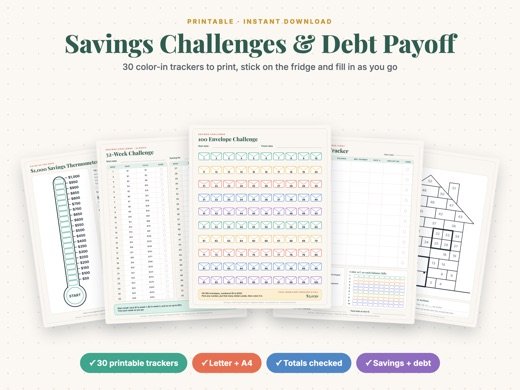
30 color-in savings challenges and debt payoff trackers: 100 envelope, 52-week, thermometers, sinking funds.
See it for $6.99How to pick the right challenge
- Look at your budget first. Find out what you can really spare each week after bills.
- Use the table above. Pick the challenge whose weekly amount fits.
- Give the money a job. "Emergency fund" or "summer trip" keeps you going better than "savings".
- Start one challenge at a time. Add another when the first feels easy.
What about debt?
If you carry high-interest debt, you may want to pay it down alongside a small savings challenge. Two common ways to plan it:
- Snowball: pay the smallest balance first for quick wins.
- Avalanche: pay the highest interest rate first, which usually costs less over time.
Tips that make it stick
- Keep your tracker where you see it every day, like the fridge.
- Move the money to a separate savings account each week, instead of keeping cash at home.
- Set up an automatic transfer on payday so you don't have to remember.
- Pair the challenge with a simple budget. If you are paid every two weeks, see how to budget a biweekly paycheck.
- Missed a week? Don't quit. Just pick up where you left off.
Printable savings challenge trackers
Our Savings Challenges & Debt Payoff Printables ($6.99) has color-in trackers for many of the challenges above: the 100 envelope chart ($5,050), the 52-week challenge in classic and reverse versions with running totals ($1,378), $1,000, $5,000 and $10,000 thermometers and color-in grids, an undated no-spend month calendar with a rules page, and sinking fund trackers for holidays, gifts, car, vacation, emergency, back to school and a blank one. For debt there's a snowball tracker, an avalanche worksheet, color-in balance bars, a credit card payoff tracker and four color-in pictures. It prints on US Letter and A4. (The penny and $5 bill challenges aren't in the pack, but the blank savings goal tracker works for them.) Want to plan every dollar? The 2027 Budget Planner ($19) is a spreadsheet for Google Sheets and other spreadsheet apps.
This guide is general information to help you organize your own money. It isn't financial advice.
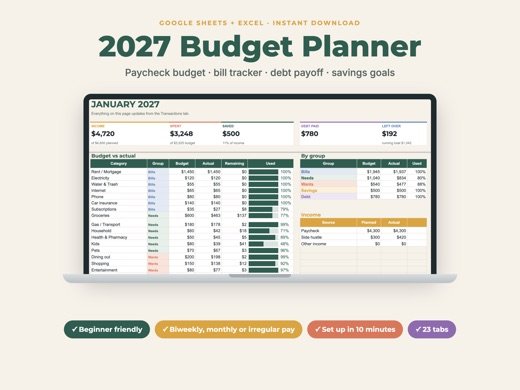
A paycheck budget, bill tracker, debt payoff and savings planner in one spreadsheet.
See it for $19Helpful resources
Try 6 printables free
A bingo card, a large-print word search, a meal plan, a chore chart, an emergency-contacts page and a practice plan. Print them tonight.